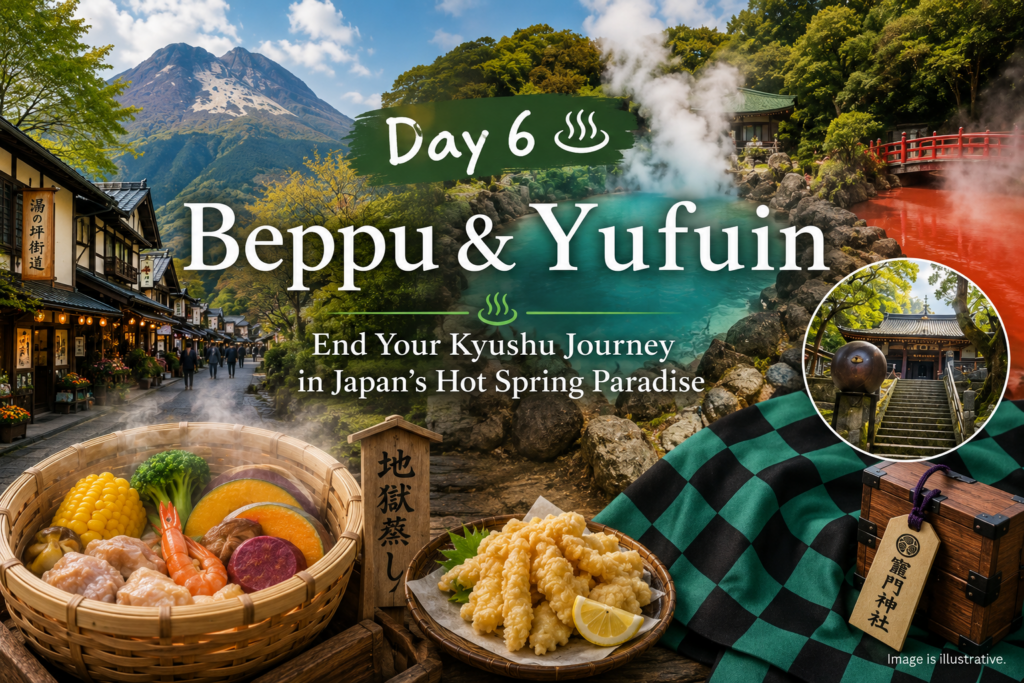
Demon Slayer is a story about humans fighting demons. There is blood, screaming, and understandably, not much time for a relaxing dinner.
But as a Japanese viewer, there is something else I have always enjoyed noticing between the battles.
The food.
Tanjiro eats udon at a street stall. Inosuke discovers tempura. Rengoku devours beef hot pot bento on a train. Mitsuri eats enough to make almost everyone else in the series look like they are fasting.
And everywhere in between, there is rice, miso soup, grilled fish, pickles, soba, onigiri and sweets.
To me, most of these foods do not feel particularly historical. In fact, that is what makes them interesting. Demon Slayer takes place more than a century ago, but sometimes I look at the table and think that I could eat almost the same meal in Japan today.
The clothes have changed. The houses have changed. Dinner, surprisingly, has not changed quite as much.
Food Means the Fighting Is Over
Once you start looking for it, there is a pattern in Demon Slayer.
People tend to eat when they are safe.
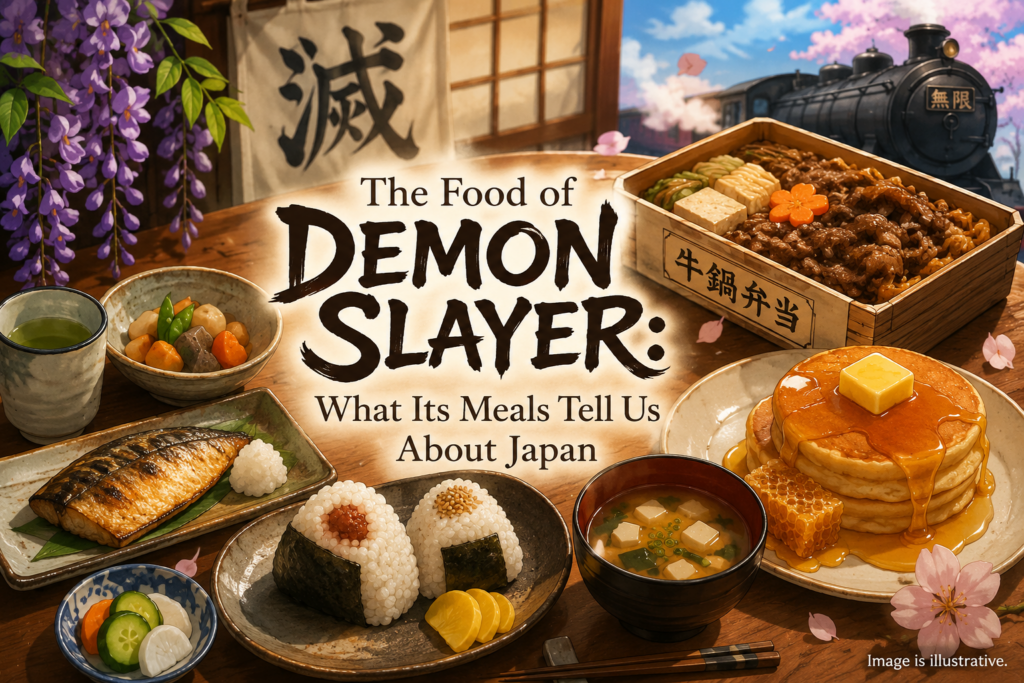
After fighting the Drum Demon, Tanjiro, Zenitsu and Inosuke recover at a house bearing the wisteria crest. Instead of another demon waiting for them, there is tempura, simmered food, miso soup and plenty of rice.
After recovering at the Butterfly Mansion, they leave with onigiri. When Tanjiro completes his brutal training with Urokodaki, his teacher prepares a special meal for him.
Personally, some of my favorite food scenes in Demon Slayer are not the extravagant ones. They are these ordinary meals after something terrible has happened.
Rice, miso soup, grilled fish, pickles and nimono, or simmered dishes, would not look unusual to me at all. You could find a similar breakfast at a Japanese ryokan today, and parts of it would not look out of place on my own family table.
That familiarity creates an interesting contrast.
A few scenes earlier, these characters were fighting for their lives. Then they sit down in front of rice and miso soup and suddenly look like ordinary Japanese teenagers again.
Perhaps that is part of why these quiet scenes feel so comforting.
The Humble Onigiri Is Everywhere
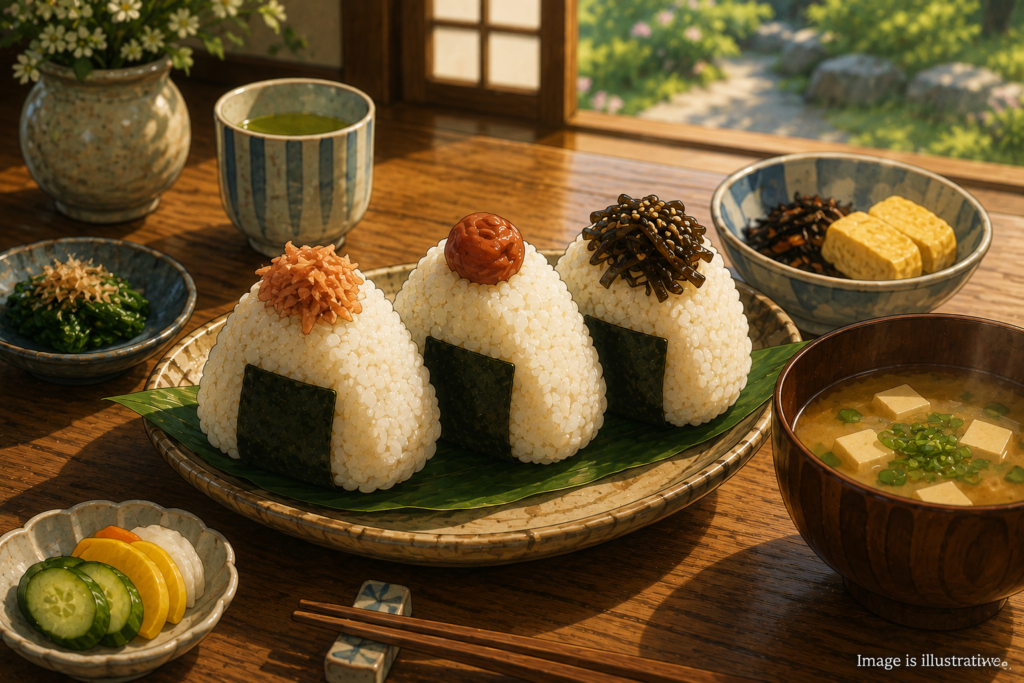
If there is one food that could probably survive the entire Demon Slayer story, it is onigiri.
Tanjiro shares one with Zenitsu. The boys receive them when leaving the Butterfly Mansion. Tanjiro brings them to Genya. Demon Slayer Corps members eat them during training.
As someone who grew up in Japan, none of this feels unusual to me.
We take onigiri on school trips. People eat them at work. Athletes eat them between games and practices. Every convenience store has shelves full of them. More than a century after the period in which Demon Slayer takes place, onigiri remains one of the easiest meals to carry around Japan.
But there is another reason I like the way Demon Slayer uses them.
Onigiri is often given from one person to another.
Someone makes it. Someone carries it. Someone offers it.
In a story full of characters who are not always very good at talking about their feelings, food becomes a simple way of taking care of someone.
Tanjiro, of course, is almost absurdly good at this.
Someone is hungry? He feeds them.
Someone is rude to him? There is still a decent chance he will feed them.
It may be the most Tanjiro form of diplomacy possible.
Want to Try Onigiri Yourself?
If you visit Japan, you do not need to find a special restaurant. Walk into almost any convenience store and you will understand immediately why onigiri works so well as travel food.
But there is another option I like for visitors.
Omusubi Gonbei is an onigiri specialist with many locations around Tokyo. What makes it particularly useful for One Bite readers is that you do not necessarily have to come to Japan to try it. The company also has locations in the United States, including New York, New Jersey and California.
So if Demon Slayer suddenly makes you want an onigiri, there is a chance you can start before your trip to Japan.
And Then There Is Rengoku
Then we come to perhaps the most memorable meal in Demon Slayer.
Rengoku. A train. A mountain of bento boxes.
Umai!
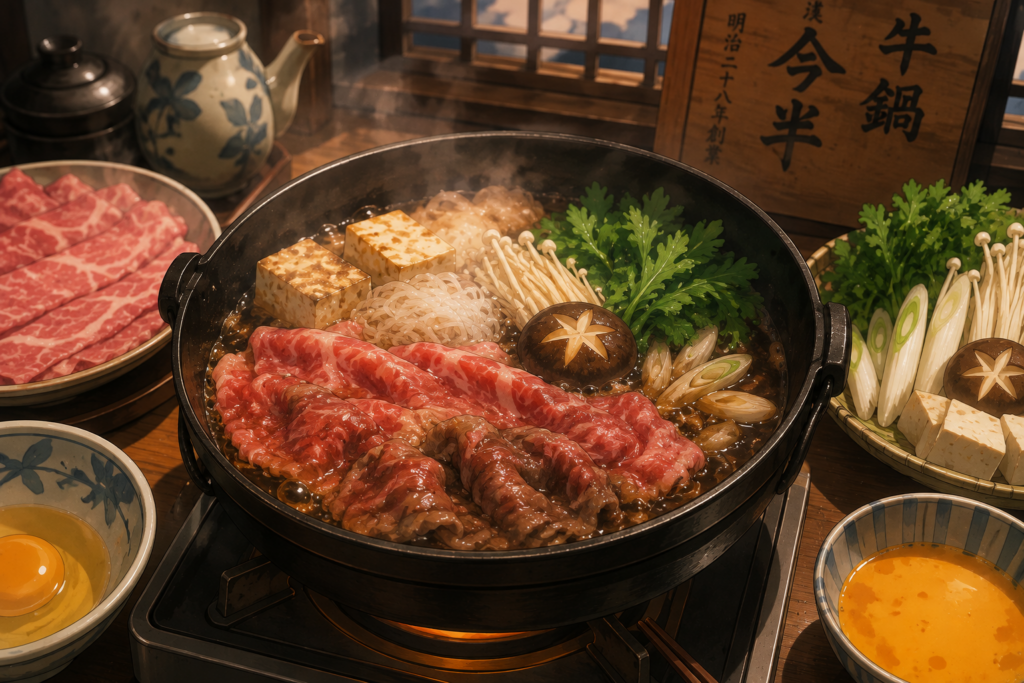
He is eating gyunabe bento, a beef hot pot style railway bento.
Rengoku makes the scene memorable simply because he seems capable of turning lunch into a major event. But the food itself is also a great fit for the period.
Demon Slayer takes place during the Taisho era, from 1912 to 1926. By then, Japan had already gone through decades of rapid modernization following the Meiji Restoration. Western influence was appearing in clothing, architecture, transportation and, of course, food.
Beef is particularly interesting.
For centuries, eating meat had been restricted or avoided for religious and cultural reasons in much of Japan. During the Meiji era, beef became increasingly associated with modernization, and gyunabe became one of the foods associated with the changing country.
That makes Rengoku eating beef on a modern train feel almost perfect for the setting.
It is not simply Japanese food.
It is food from a Japan that was changing.
You Can Still Eat This Side of Japan
This is where Demon Slayer can actually become part of a trip to Japan.
If Rengoku’s meal makes you want beef hot pot, Tokyo still has restaurants connected to this history.
Imahan is one of the famous names. Its history goes back to a beef hot pot restaurant established in 1895, during the Meiji era, and Imahan opened in Asakusa in 1913.
That date caught my attention.
1913 is almost exactly the Japan in which Demon Slayer is set.
Of course, sitting down for sukiyaki today is not the same thing as eating Rengoku’s railway bento. But if you want to taste the kind of beef culture that was developing around the period of Demon Slayer, this is a much more interesting experience than simply ordering a themed anime meal.
Personally, this is the kind of anime pilgrimage I prefer.
You do not have to recreate the fictional food exactly. Sometimes it is more interesting to eat the real food culture that existed behind it.
The Sweets Tell Us Something Too
The changing Japan of Demon Slayer becomes even more obvious when you look at sweets.
There are plenty of traditional Japanese sweets such as dango, yokan, senbei, ohagi and sakura mochi.
Then suddenly there is castella.
Anpan.
Pancakes.
At first, that combination can look strange to someone imagining old Japan as a world of nothing but traditional Japanese food. Historically, however, it makes sense.
Western confectionery had already entered Japan during the Meiji era. By the Taisho period, Western style sweets and cafes were becoming increasingly familiar, particularly in cities. Traditional wagashi did not disappear, of course. Both existed together.
That mixture is something I really like about the Taisho setting.
Japan was becoming modern, but the old Japan had not vanished.
You can see both on the same table.
And somehow, Mitsuri Kanroji feels like the perfect person to stand in the middle of all of it.
Mitsuri May Have the Best Food Scenes
Mitsuri loves food.
No complicated cultural analysis is required here.
She really loves food.
One of the foods most closely associated with her is sakura mochi, the pink rice cake wrapped in a salted cherry leaf. Within the wonderfully ridiculous logic of Demon Slayer, eating enormous quantities of sakura mochi is even connected to her distinctive hair color.
And then there are the pancakes.
Tanjiro visits Mitsuri and gets pancakes topped with honeycomb.
If I could choose only one food from Demon Slayer to eat, I think I would choose this.
The beef bento is tempting.
But honeycomb pancakes win.
Sorry, Rengoku.
There is something else I like about Mitsuri’s relationship with food. She does not pretend to eat less in order to appear more feminine. She is hungry, she eats an enormous amount, and she enjoys every second of it.
That fits her personality perfectly.
She loves openly. She worries openly. She eats openly.
In a story filled with people hiding enormous parts of themselves, Mitsuri is refreshingly bad at hiding who she is.
Food Tells Us Who These People Are
This may be the part I find most interesting.
Look at who eats comfortably around other people.
Tanjiro does. Inosuke certainly does. Mitsuri definitely does. Rengoku can somehow turn eating a bento into a performance.
They are also some of the most emotionally direct characters in the story.
Other characters are much harder to read. Their real feelings are buried beneath silence, anger or formality. Interestingly, food sometimes appears when those barriers begin to fall.
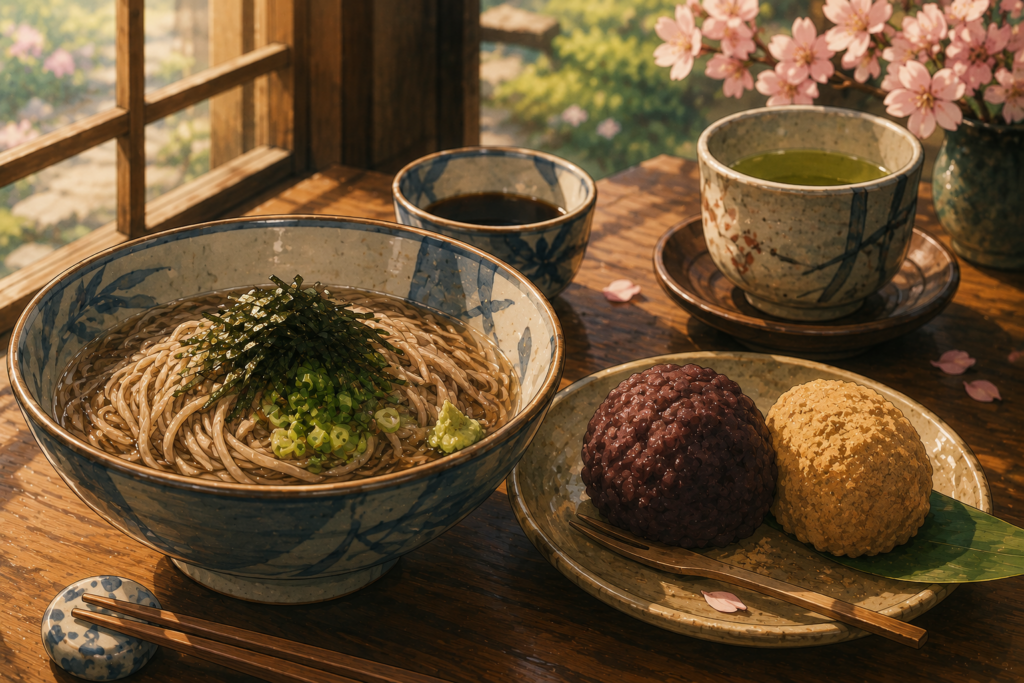
Eating soba with Giyu feels different once you understand who Giyu really is.
Then there is Sanemi, one of the most intimidating Hashira, who happens to love ohagi.
I have always liked details like this.
The Hashira can sometimes feel almost superhuman when they fight. Then you discover what they like to eat and suddenly they become ordinary people again.
That matters in Demon Slayer because so many of these characters are young people living with death every day.
When there are no demons around, what do they want?
A hot meal. Something sweet. And sometimes, someone to eat with.
That part has not changed much in a hundred years either.
And What About Itadakimasu?
There is one Japanese expression anime fans have probably heard thousands of times before all these meals.
Itadakimasu.
As a Japanese person, this word is so ordinary to me that I rarely think about it. I have probably said it thousands of times since childhood.
That is why I found it interesting when I began noticing how anime subtitles handle it.
It is often translated as something similar to Let’s eat.
That works for the scene. But it is not quite the same thing.
Itadakimasu comes from itadaku, a humble verb meaning to receive.
And I can say itadakimasu when I am eating completely alone.
So who am I talking to?
When you stop and think about it, it is actually a rather strange expression.
It is not simply an announcement that dinner is starting. At its core is the idea that you are receiving the food in front of you.
After looking at the meals throughout Demon Slayer, that distinction starts to feel especially appropriate.
Again and again, food in this story is received from someone.
A teacher cooks for his student after training. A family gives injured Demon Slayers somewhere safe to sleep and something to eat. Someone prepares onigiri for a journey. Someone offers food to a friend.
For a story filled with swords and demons, an extraordinary amount of time is spent with someone feeding someone else.
The Quiet Side of Demon Slayer
When I first watched Demon Slayer, I certainly was not analyzing the food.
I was watching the sword fights, the demons and the Hashira like everyone else.
But when I went back and started looking specifically at the meals, I realized how many things I had barely noticed because they felt so ordinary to me.
Rice and miso soup.
Onigiri.
Food prepared for someone else.
And itadakimasu before eating.
None of these things is spectacular. Maybe that is precisely why I like them.
The battles show us what these characters are willing to die for.
The meals show us what they are trying to live for.
So next time you watch Demon Slayer, forget the breathing techniques for a moment and look at the table.
There may be more of Japan sitting there than you realized.
References
- Demon Slayer: Kimetsu no Yaiba, Official Shonen Jump Website
Official information on the Demon Slayer manga, related publications, and official fan books. - National Diet Library, The History of Dining Out in Modern Japan
Historical material on the development of Western influenced dining in Japan during the Meiji and Taisho periods, including the spread of gyunabe and other forms of modern dining. - Asakusa Imahan, Company History
Official history of Asakusa Imahan. The company traces its origins to a beef hot pot restaurant established in 1895, with Imahan opening in Asakusa in 1913. - Ministry of Agriculture, Forestry and Fisheries, Thinking About Japan Through Onigiri
An official overview of onigiri as a traditional Japanese food and its relationship with Japanese ingredients and regional food culture. - Omusubi Gonbei, Official Website
Official information on the Japanese onigiri specialist introduced in this article.