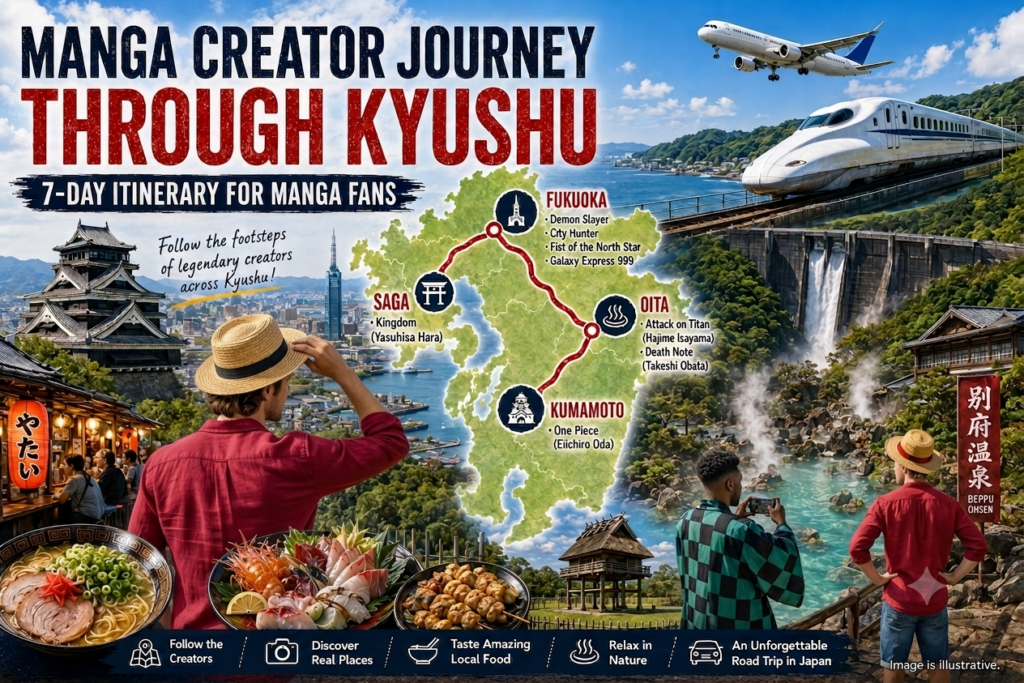
Want to experience the full Kyushu manga creator journey? Start here: From Tokyo to Kyushu: The Ultimate Manga Creator Journey Through Japan
After several exciting days following manga legends across Kyushu, it is time to slow the pace.
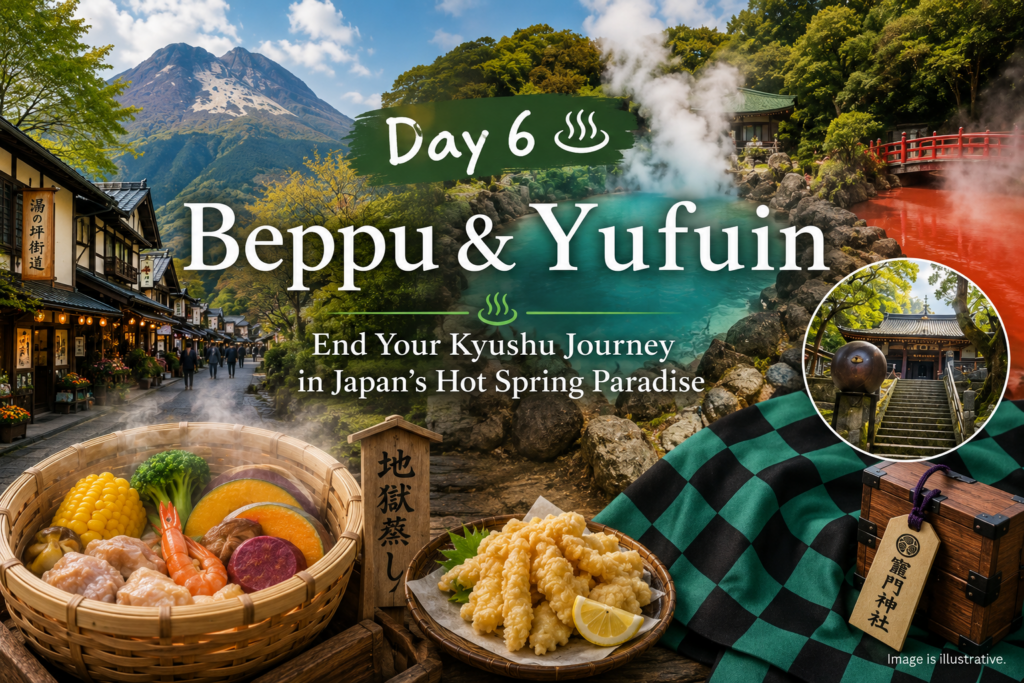
From Hita, the hometown of Attack on Titan creator Hajime Isayama, continue east through Oita Prefecture to Yufuin and Beppu, two of Japan’s best known hot spring destinations.
Spend the final part of your journey soaking in an onsen, staying at a traditional Japanese ryokan, and discovering some of Oita’s distinctive local food.
There is also one last stop for anime fans along the way.
How to Get from Hita to Yufuin and Beppu
Driving is the easiest option for this part of the journey.
From Hita to Yufuin, the drive takes approximately 1 hour. From Yufuin to Beppu, allow another 40 to 50 minutes.
If you skip Yufuin and travel directly from Hita to Beppu, the journey takes approximately 1 hour 30 minutes by car.
A good itinerary is to leave Hita in the morning, spend several hours exploring Yufuin, and then continue to Beppu in the afternoon.
Public transportation is also available, but a rental car gives you considerably more flexibility, especially if you are following the full Kyushu itinerary.
Beppu or Yufuin?
Beppu and Yufuin are two of Oita’s most famous hot spring destinations, but they offer different experiences.
Yufuin is a smaller, quieter hot spring resort known for scenic walks, cafes, and traditional ryokan. Beppu is a larger hot spring city with more attractions, including the Seven Hells, jigoku mushi cooking, and local restaurants.
Choose Yufuin for a peaceful ryokan stay and Beppu for more sightseeing and food.
For this trip, we recommend visiting Yufuin on the way from Hita and staying overnight in Beppu, so you can enjoy both.
Yufuin
Yufuin sits at the foot of Mount Yufu and is ideal for a relaxed afternoon of walking, visiting cafes and small shops, enjoying the scenery, and stopping for an onsen.
If you prefer a quieter ending to your Kyushu journey, you can also stay overnight here rather than continuing to Beppu.
Where to Stay in Yufuin: Sanso Murata
For a memorable final night in Kyushu, Sanso Murata is one of Yufuin’s distinctive luxury ryokan.
The property has only 12 guest rooms, each with its own character. It is a good choice for travelers who want the ryokan stay itself to become one of the highlights of the journey.
Beppu Onsen
From Yufuin, continue approximately 40 to 50 minutes by car to Beppu.
Steam rises throughout the city, making geothermal activity part of the landscape itself.
You can soak in traditional baths, explore geothermal attractions, experience hot spring steam cooking, and spend the night in an onsen ryokan.
Beppu Official Tourism Website
Beppu Jigoku Meguri
One of Beppu’s most famous experiences is Jigoku Meguri, or the Seven Hells of Beppu.
These are not hot springs for bathing. They are extremely hot geothermal pools and vents that have been visited as sightseeing attractions for generations.
There are seven official hells, and each looks different.
Umi Jigoku, or Sea Hell, is famous for its striking cobalt blue water despite reaching about 98 degrees Celsius.
Chinoike Jigoku, or Blood Pond Hell, is a dramatic red pool colored by naturally occurring minerals and hot mud.
Tatsumaki Jigoku is a geyser that periodically sends hot water and steam into the air.
The remaining four are Shiraike Jigoku, Oniishibozu Jigoku, Oniyama Jigoku, and Kamado Jigoku.
Five of the seven are located close together in the Kannawa area and can be explored on foot. Chinoike Jigoku and Tatsumaki Jigoku are about three kilometers away, so traveling between the two areas by car or bus is more convenient.
If you have limited time, Umi Jigoku, Chinoike Jigoku, and Tatsumaki Jigoku provide three very different examples of Beppu’s geothermal landscape.
Official Beppu Jigoku Meguri Website
A Demon Slayer Spot Discovered by Japanese Fans
Before settling into your ryokan, anime fans may want to make one more stop.
Hachiman Kamado Shrine is located in the Uchikamado area of Beppu, approximately five minutes by car from JR Kamegawa Station.
The shrine has no official connection to Demon Slayer: Kimetsu no Yaiba. However, Japanese fans began visiting it after noticing several similarities between the shrine and elements of the series.
The most obvious connection is its name. Kamado is written with the same Japanese characters used in the family name of protagonist Tanjiro Kamado.
Inside the shrine is a ceiling painting of a dragon water deity that fans have compared with the dragon imagery associated with Tanjiro’s Water Breathing, Tenth Form: Constant Flux.
There is also a roughly 500 year old sacred tree called Tamayori no Ki. Tamayori has the same pronunciation as Tamayo, one of the important characters in Demon Slayer.
Another unusual object is a large naval mine displayed on the shrine grounds. Its massive iron ball shape has attracted attention because it resembles the chained iron ball weapon used by Gyomei Himejima.
The shrine also has a flight of 99 stone steps connected to a local legend that says an oni built them in a single night.
None of these connections have been officially established by the manga’s creator or rights holders. Hachiman Kamado Shrine is best understood as an unofficial pilgrimage spot whose similarities to Demon Slayer were discovered and shared by Japanese fans.
Oita Prefecture Guide to Hachiman Kamado Shrine
Where to Stay in Beppu
Sanso Kannawaen
If you want to finish the trip with a more luxurious onsen experience, Sanso Kannawaen is an excellent option in the Kannawa area.
The ryokan has its own hot spring source, and selected rooms include private baths. Its location is also convenient for exploring the Kannawa area and the Beppu Hells.
Sanso Kannawaen Official Website
Hana Beppu
For travelers who prioritize convenience, Hana Beppu is another good option.
It is about a six minute walk from the west exit of JR Beppu Station, making it particularly useful if you plan to return your rental car or continue your journey by train.
Jigoku Mushi: Cooking with Hot Spring Steam
One of the most distinctive experiences in Beppu is jigoku mushi.
Instead of using a conventional stove, ingredients are placed inside special cooking chambers and steamed using naturally occurring geothermal steam.
The Classic Choice: Jigoku Mushi Kobo Kannawa
For first time visitors, Jigoku Mushi Kobo Kannawa is one of the easiest places to experience this tradition.
Visitors use geothermal steam chambers called jigoku gama to cook their food themselves.
It is a popular attraction, so expect crowds during weekends and peak travel periods.
Beppu Official Tourism Website
A Different Experience: Mushicharo
If you would rather experience jigoku mushi as a carefully prepared meal, consider Mushicharo.
The restaurant combines Beppu’s traditional geothermal steaming technique with seasonal ingredients and concepts from yakuzen cuisine.
Instead of simply steaming ingredients yourself, you can experience jigoku mushi as a complete course meal.
Reservations are required by the previous day.
Try Toriten at Toyoken
Another food you should try before leaving Oita is toriten.
Toriten is chicken prepared in a tempura style and is one of Oita’s best known regional dishes.
One of the most famous places to try it is Toyoken in Beppu, which is widely known as the birthplace of toriten.
For your first toriten experience in Oita, it is difficult to find a more appropriate place.
Beppu Reimen at Rokusei
Beppu also has its own distinctive style of cold noodles.
Beppu reimen typically combines chewy noodles containing buckwheat flour with a refreshing broth, beef, and kimchi.
Rokusei is one of the city’s best known specialists and makes its noodles in house.
After a long day of sightseeing and hot springs, a cold bowl of Beppu reimen is a great way to finish the evening.
The Perfect End to Your Kyushu Journey
From Tokyo to Kyushu, this journey has followed manga creators, stories, and places connected to some of Japan’s most influential works.
The final day is different.
There is no need to rush from one manga location to another. Walk through Yufuin, discover an unofficial Demon Slayer spot, see the extraordinary geothermal landscape of Beppu, eat food cooked with hot spring steam, and spend the night in a Japanese ryokan.
Anime and manga may have been the reason to begin the journey, but they can also become a gateway to discovering much more of Japan.
And after a week exploring Kyushu, there are few better ways to finish than sitting in a hot spring and doing absolutely nothing.