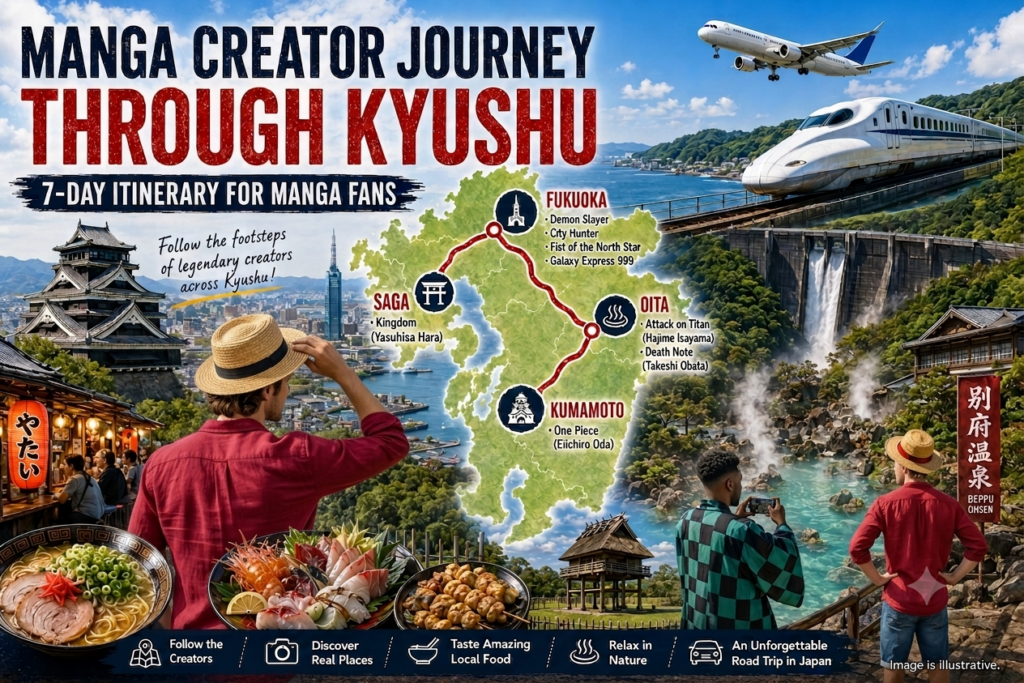
Want to experience the full Kyushu manga creator journey? Start here: From Tokyo to Kyushu: The Ultimate Manga Creator Journey Through Japan
After two days exploring Fukuoka, it is time to head west to Saga Prefecture.
Saga is easy to reach from Fukuoka. From Hakata Station, a limited express train reaches Saga Station in about 40 minutes. The journey takes around one hour by car, making Saga suitable for either a day trip or an overnight stay.
At first glance, Saga may seem like a quiet destination. It does not have the neon streets of Tokyo or the famous castles of Osaka. Yet for manga fans, few places in Japan have quite the same connection to Kingdom.
Saga is the hometown of Yasuhisa Hara, the creator of one of Japan’s most successful manga series.
Unlike some anime destinations, Saga does not rely on a permanent theme park or a recreation of the story’s battlefields. Instead, it offers the chance to discover the history, regional culture, food, and landscapes of the prefecture where the creator grew up.
For readers who want to look beyond the pages of Kingdom, Saga is a natural place to begin.
What Is Kingdom?
Even people who have never read Kingdom are likely to recognize its name in Japan.
Serialized in Weekly Young Jump since 2006, the manga has sold more than 120 million copies, including digital editions. Volume 79 was released in May 2026.
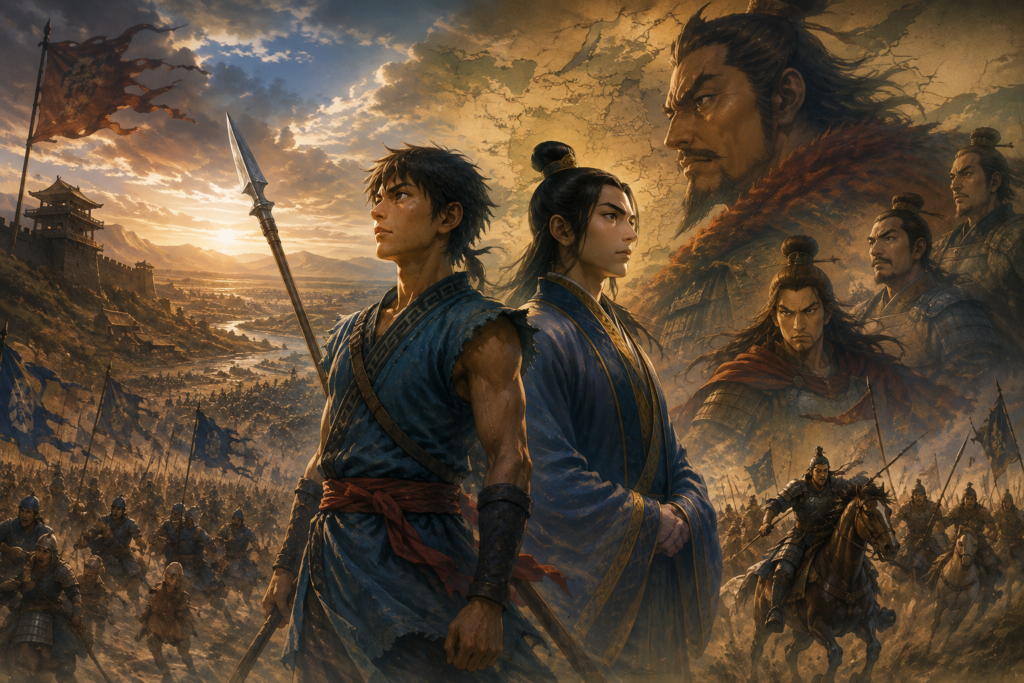
The story follows Shin, a war orphan who dreams of becoming the greatest general under the heavens, and Ei Sei, the young king of Qin who seeks to unite China for the first time in history.
Shin begins life with almost nothing. He is not born into a powerful family and has no privileged position. Through war, loss, friendship, and relentless ambition, he gradually rises from a servant to a soldier and eventually toward the rank of general.
Kingdom is based on real historical figures and events, but it is not a straightforward retelling of history.
Yasuhisa Hara uses the historical record as a foundation, then fills its gaps with dramatic battles, larger than life generals, political intrigue, sacrifice, loyalty, and the emotional intensity of a modern manga.
The result is a story that makes ancient history feel immediate.
Kingdom is moderately well known overseas through its manga, anime adaptation, and live action films. In Japan, however, its presence is much larger. It is one of the country’s defining modern manga series, read not only by dedicated manga fans but also by people drawn to its themes of leadership, perseverance, strategy, and ambition.
Why Saga Matters
Yasuhisa Hara was born in Saga Prefecture, and the connection between Kingdom and his hometown has grown stronger over the years.
Saga has hosted numerous official collaborations celebrating both the series and the prefecture.
These projects do more than place character panels at tourist attractions. They connect Kingdom with local traditions, historic sites, transportation, hot spring towns, and regional crafts.
For Kingdom fans, Saga is not a filming location or the historical setting of the story.
It is the hometown of the person who created it.
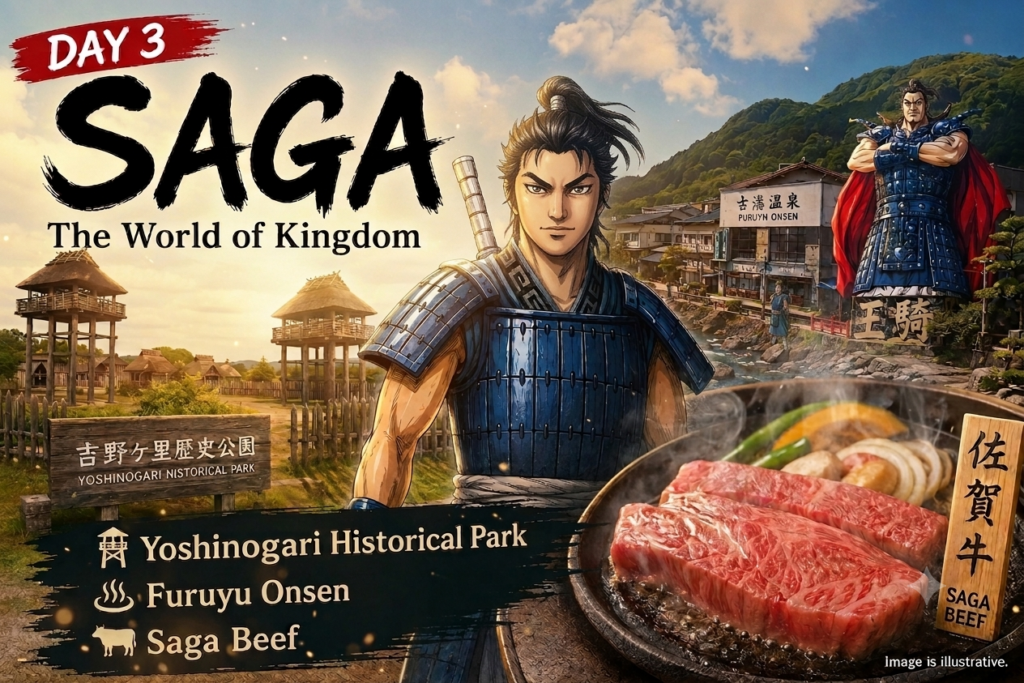
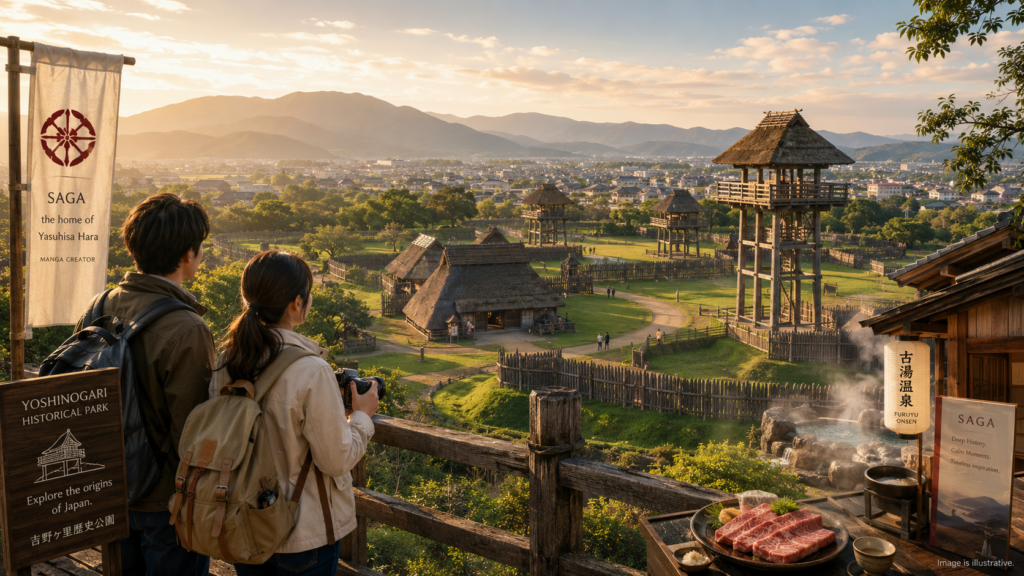
Yoshinogari Historical Park
The most important stop on a Kingdom inspired trip through Saga is Yoshinogari Historical Park.
From Saga Station, the train journey to Yoshinogari Koen Station takes about 15 minutes. The park is then approximately a 15 minute walk from the station.
Yoshinogari is one of Japan’s largest archaeological sites from the Yayoi period. The park preserves the remains of an ancient fortified settlement and reconstructs watchtowers, defensive moats, storehouses, homes, gates, and ceremonial buildings.
Kingdom takes place in ancient China, while Yoshinogari represents a different society in ancient Japan.
Even so, walking through the site makes the development of an early civilization easier to imagine.
The high watchtowers and wooden fortifications reveal how communities monitored their surroundings and protected themselves. The granaries show how food was stored and controlled. The arrangement of residential, ceremonial, and defensive areas offers a clearer picture of how a settlement could become increasingly organized and politically complex.
These details give physical scale to ideas that frequently appear in Kingdom.
Armies and generals dominate the manga, but every kingdom also depended on ordinary people who built walls, produced food, guarded entrances, and maintained the community behind the battlefield.
Experience Ancient Japan
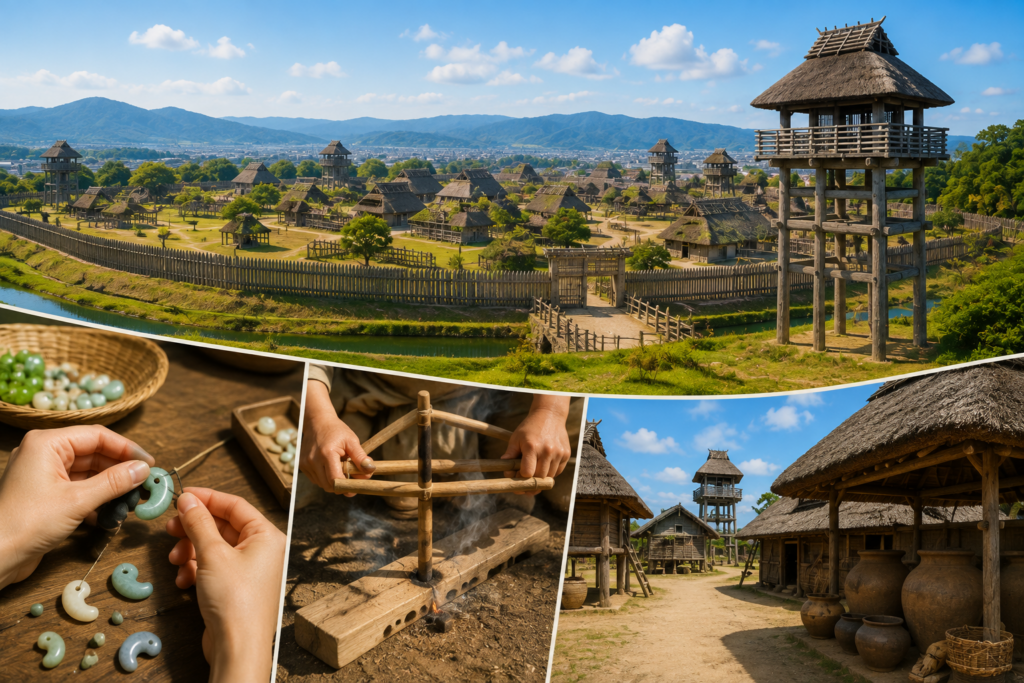
Yoshinogari is more than an open air museum.
Depending on the season and program schedule, visitors can make traditional magatama beads, learn ancient fire making techniques, and experience parts of daily life from the Yayoi period.
Rather than rushing between the largest reconstructed buildings, take time to explore the wider settlement.
Walk through the residential areas, granaries, burial grounds, defensive moats, and watchtowers. Seeing how these spaces relate to one another provides a much clearer understanding of how an ancient community functioned.
The park is large, so allow at least two or three hours for your visit.
Travelers with a strong interest in archaeology or ancient history could easily spend half a day here.
Kingdom Collaboration Events
Saga continues to celebrate its connection with Kingdom through official collaborations.
The 20th anniversary campaign in 2026 brought Kingdom themed projects to several parts of the prefecture.
One of the most visible was Saga Kingdom Airport, where the airport was decorated with artwork and displays connected to the series.
Other projects included exhibitions combining Kingdom with Arita ware, one of Saga’s most celebrated traditional crafts.
Along the Ariake Sea, the Kingdom Complete Manga Seawall displayed every page from Volumes 1 through 77 across a stretch of more than 300 meters.
Kingdom themed buses also traveled through the prefecture, while Furuyu Onsen became the setting for a large hot spring town collaboration.
What makes these projects distinctive is their connection to local culture.
Rather than creating temporary anime displays that could appear anywhere in Japan, Saga combines Kingdom with regional pottery, coastal scenery, transportation, and traditional hot spring communities.
The events are seasonal and may not be available throughout the year. Check the official Saga Prefecture and Kingdom websites before planning a visit around a specific collaboration.

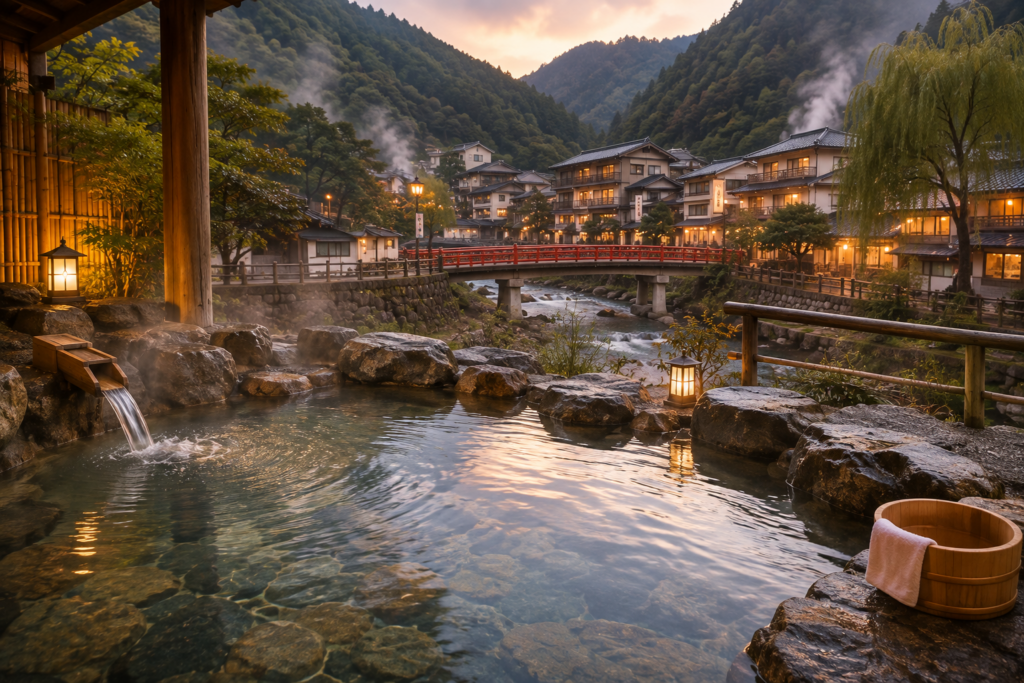
Furuyu Onsen
After exploring Yoshinogari, continue north into the mountains to Furuyu Onsen.
From Saga Station, the journey takes approximately 50 minutes by bus or around 30 minutes by car.
Furuyu is a quiet hot spring town known for its gentle, lukewarm mineral water. Rather than entering an intensely hot bath for a few minutes, visitors can soak slowly and allow the body to relax over a longer period.
During the 2026 collaboration, the town was transformed into Furuyu Kingdom Onsen Village.
Visitors could find photo spots featuring Shin, Ei Sei, Ouki, Kyou Kai, and other characters throughout the town.
One of the most striking installations was a giant Ouki display measuring approximately eight meters in height.
A special stamp rally encouraged visitors to explore different parts of the town. As more stamps were collected, an image of the Hi Shin Unit gradually appeared.
Furuyu also has an unexpected connection to the historical world behind Kingdom.
According to local legend, Xu Fu traveled east under the orders of Qin Shi Huang in search of an elixir of immortality and eventually reached this region of Japan.
The story belongs to the border between history and folklore. Still, the connection to Qin Shi Huang gives Kingdom fans another reason to view the town with curiosity.
Saga Beef
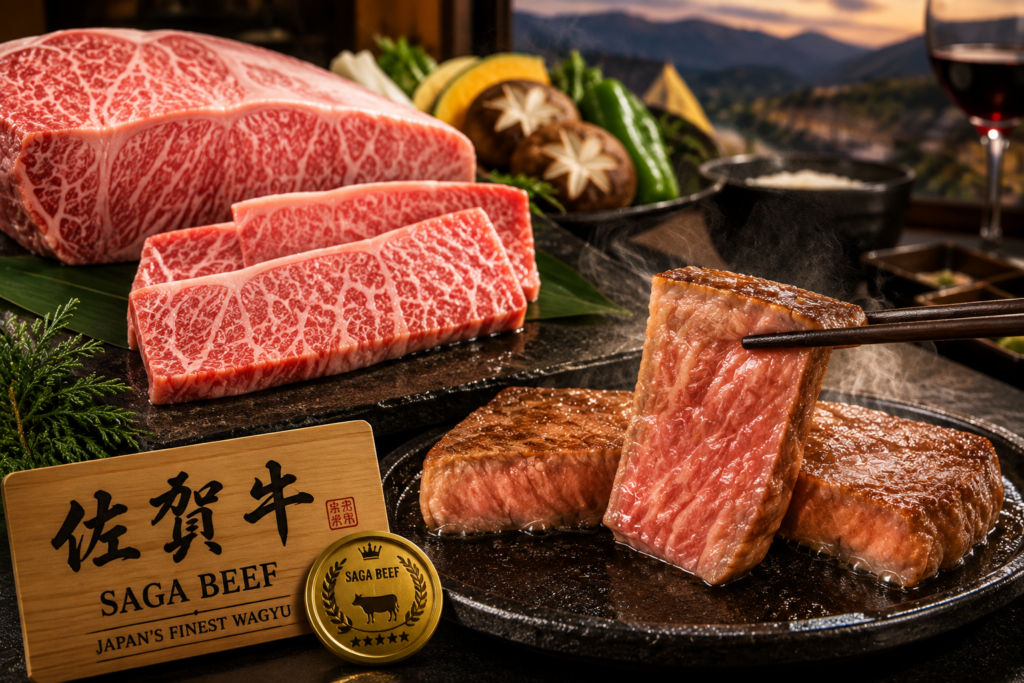
No trip to Saga feels complete without trying Saga Beef.
Saga Beef is regarded as one of Japan’s finest wagyu brands. It is prized for its delicate marbling, soft texture, and rich flavor.
Unlike Kobe Beef or Matsusaka Beef, Saga Beef remains something of a hidden gem for many international travelers.
Saga produces fewer cattle than Japan’s larger wagyu regions, so the beef is less commonly encountered overseas. For many visitors, Saga becomes the first place where they experience one of Japan’s most exclusive regional wagyu brands.
One of the best places to try it is Saga Beef Restaurant Kira Honten.
Operated by JA Group Saga, the restaurant serves Saga Beef as steak, teppanyaki, sukiyaki, and shabu shabu.
Recommended Restaurant in Saga
Saga Beef Restaurant Kira Honten
Travelers who cannot visit Kyushu can still try authentic Saga Beef in Tokyo.
Saga Beef Restaurant Ginza Kira is located in central Ginza and offers premium Saga Beef without requiring a journey to Saga.
Recommended Restaurant in Tokyo
Saga Beef Restaurant Ginza Kira
Recommended Stay
Saga City is the most convenient base for travelers who value easy transportation and a wide choice of restaurants.
It is also useful for visitors continuing to Nagasaki or Kumamoto on the following day.
For a quieter experience, stay overnight in Furuyu Onsen.
Traditional ryokan, mountain scenery, and slow bathing offer a sharp contrast to the energy and tension of Kingdom’s battlefields.
Saga can be visited as a day trip from Fukuoka, but staying overnight allows more time for Yoshinogari, the hot springs, and a relaxed Saga Beef dinner.
References
Saga Prefecture Official Tourism
Kingdom and Saga Official Collaboration