Studio Ghibli is not simply a famous animation studio in Japan. For many Japanese people, Ghibli is part of childhood itself. A single image can instantly feel like Ghibli, and just a few seconds of Joe Hisaishi’s music can bring back memories of sitting in front of the television as children.
We grew up before streaming made it possible to watch almost any film whenever we wanted. Japanese children watched the same movies again and again on VHS or DVD, or waited for Ghibli films to return to television.
Because of this, it is not unusual in Japan to know Ghibli films that were released before you were born. People born in the 1990s grew up with films from the 1980s, and people born in the 2000s came to know those same films as well. Parents and children know the same movies, remember the same scenes, and recognize the same music.
That is what Ghibli is in Japan.
In this article, we introduce 14 films that we believe are worth watching at least once from a Japanese perspective. The Castle of Cagliostro and Nausicaä of the Valley of the Wind were released before Studio Ghibli was founded, but both are essential to understanding what came later, so we have included them here.
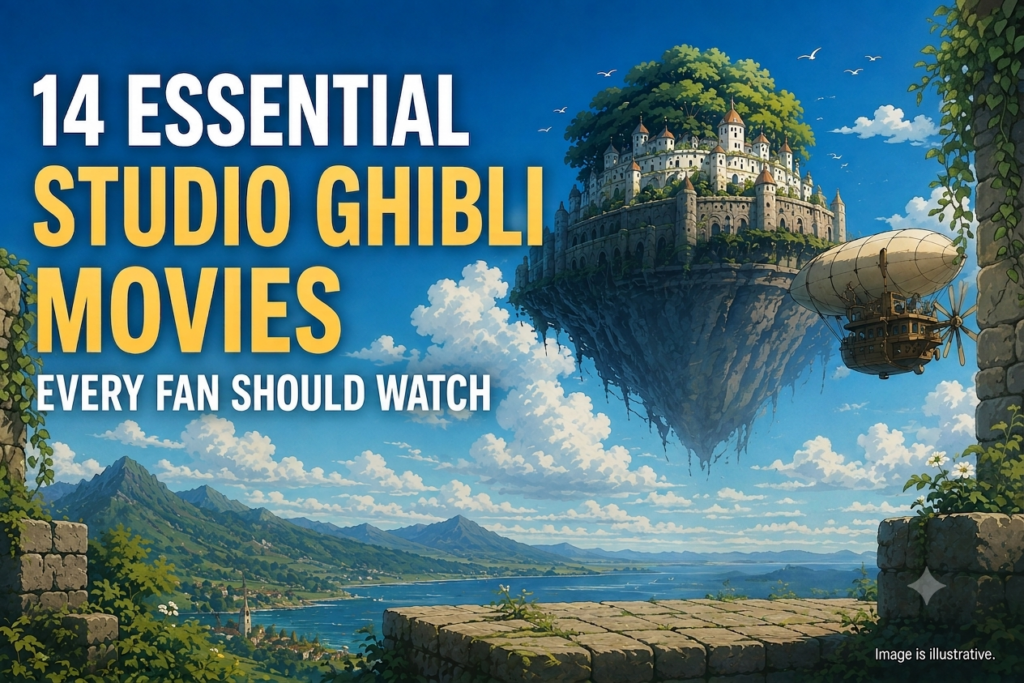
1. Lupin the Third: The Castle of Cagliostro
Released in 1979, The Castle of Cagliostro was Hayao Miyazaki’s feature film directorial debut. Studio Ghibli did not yet exist.
Even so, anyone familiar with Miyazaki’s later work can recognize many elements that would eventually become part of his visual language. Cars race with tremendous energy. Buildings are drawn with remarkable detail. Characters devour food with enthusiasm. Action makes constant use of height and physical space. Personality is often revealed through movement rather than dialogue.
If you begin Ghibli’s history only in 1985, you miss an important part of Miyazaki’s creative origins.
One Bite Pick
This is one of the best films for seeing Miyazaki before Ghibli existed.
It is also connected to an important relationship in Ghibli history. Toshio Suzuki, who would later become one of the producers most closely associated with Miyazaki, first began coming into contact with him around the period when this film was being made.
Watching The Castle of Cagliostro after already knowing Ghibli makes it easier to see how much of the future was already beginning to take shape.
2. Nausicaä of the Valley of the Wind
Nausicaä of the Valley of the Wind is often discussed as if it were a Studio Ghibli film, but it was released in 1984, one year before the studio was founded.
The film presents a world dominated by the Toxic Jungle, giant insects, environmental collapse, and conflict between human societies. At first glance, it is an epic fantasy, but many themes that Miyazaki would return to throughout his career are already here.
Nature and humanity. War. Civilization. Fear. Hatred.
One Bite Pick
If you enjoy the film, do not stop there.
Miyazaki also created the original Nausicaä manga, and its story extends far beyond what appears in the movie. He continued drawing it even after the film was released, and the manga eventually developed into a much larger and more complex work.
If the world of Nausicaä draws you in, the manga is well worth reading.
3. Castle in the Sky
Released in 1986, Castle in the Sky was the first feature film produced after Studio Ghibli was founded.
A legendary floating island. A mysterious girl. A boy who dreams of the sky. Air pirates, giant airships, robots, and the remains of a lost civilization.
Today it is recognized as one of Ghibli’s classic adventure films, but this is also where the studio’s feature film history truly began.
One Bite Pick
Few films better represent the relationship between Ghibli and Japanese television culture.
In Japan, many viewers wait for one particular moment near the end whenever Castle in the Sky is broadcast on television.
Balse.
During a television broadcast on August 2, 2013, viewers posted the word on Twitter at the exact moment it was spoken, reportedly reaching 143,199 tweets per second and dramatically surpassing the previous world record at the time.
A film released more than 25 years earlier was still being watched across Japan, with huge numbers of people waiting for exactly the same moment.
That says a great deal about how deeply Castle in the Sky became embedded in Japanese popular culture.
The ending song, Carrying You, is equally familiar. It has long been used in Japanese school music education and has appeared in elementary and junior high school music textbooks.
Even people who have not watched the film in years may still recognize the song immediately.
Through cinema, television, and school music classes, Castle in the Sky has remained part of Japanese memory across generations.
4. My Neighbor Totoro
Totoro is famous around the world, but its place in Japan is even more special.
There is no great villain. No battle to save the world.
The story simply follows two sisters who move to the countryside and encounter mysterious creatures living nearby.
Summer skies, rice fields, forests, an old house, rain, and a bus stop.
For Japanese viewers, My Neighbor Totoro is fantasy, but it also feels strangely familiar.
One Bite Pick
One fact still surprises many people outside Japan.
My Neighbor Totoro and Grave of the Fireflies were released together as a double feature in 1988.
Today both are regarded as major works in the history of Japanese animation, yet emotionally they could hardly be more different.
Totoro later became the symbol of Studio Ghibli itself.
More importantly, it is not only people who were children in 1988 who know Totoro. Children born years later also grew up watching it.
If you want to understand how Ghibli became something shared across generations in Japan, Totoro is one of the best places to begin.
5. Grave of the Fireflies
Grave of the Fireflies is an important film not only for Japanese viewers, but for audiences around the world.
Directed by Isao Takahata, it follows a brother and his young sister during the final months of World War II in Japan.
There is no magic, no flying castle, and no mysterious creature.
Yet few animated films leave such a powerful and lasting impression.
One Bite Pick
Many Japanese people first watched Grave of the Fireflies as children, simply because it was a Ghibli film.
Then they discovered how painful it was.
For some, the experience was so difficult that they never wanted to watch it again. And yet many of those same people grow up feeling that when their own children are old enough, this is one film they should see at least once.
It is not a film people return to because it is comforting.
It is a film many feel should not be forgotten.
There is also an unusual detail in Japan today. While most Ghibli films are not available through major subscription streaming services in Japan, Grave of the Fireflies can be watched on Netflix.
Even within the Ghibli catalog, it occupies a unique position.
6. Kiki’s Delivery Service
Kiki is a 13 year old witch who leaves home and begins living alone in an unfamiliar city.
At first glance, it may look like a gentle fantasy about magic.
But when you watch it again as an adult, it can feel like a completely different film.
Moving somewhere new. Starting work. Comparing yourself with other people. Losing confidence. Suddenly becoming unable to do something that once felt natural.
One Bite Pick
Pay attention not only to Kiki’s magic, but to Kiki as a worker.
The story is not about becoming more powerful. It is about discovering what you can do and using that ability to create a place for yourself in society.
A film that once felt like an adventure in childhood can feel surprisingly realistic after you begin working yourself.
That is one of the reasons Kiki’s Delivery Service changes so much with age.
7. Porco Rosso
The main character is a pig.
But do not mistake this for a children’s animal movie.
Set around the Adriatic Sea, Porco Rosso follows a bounty hunter who flies a seaplane, surrounded by air pirates, aircraft, memories of war, and adults trying very hard to look cool.
For many Japanese viewers, the film becomes much more appealing somewhere around their late teens or twenties.
One Bite Pick
The famous Japanese advertising line for the film was Coolness means this.
At first glance, Porco Rosso can look like a very masculine film from the early 1990s. A middle aged male hero. Planes. Drinking. Rivalries. Men constantly performing toughness.
Then you actually watch it.
The women are remarkably capable.
Fio designs aircraft, argues with older men, takes responsibility for her work, and refuses to be intimidated. The women at Piccolo’s workshop simply get on with building the plane. Gina has her own life, her own strength, and her own decisions to make.
Meanwhile, the men compete, boast, show off, and protect their pride.
That contrast is part of what makes the film so entertaining.
As a child, you may only see the airplanes. As an adult, you begin to notice the people.
That is when Porco Rosso often becomes much cooler.
8. Princess Mononoke
Released in 1997, Princess Mononoke is one of Studio Ghibli’s most ambitious films.
Its world is generally understood to evoke Japan around the 16th century, a period when political power, warfare, technology, and control over natural resources were changing rapidly.
But this is not simply a historical fantasy or an environmental message.
The natural world here is not gentle. Gods take the form of enormous animals, and they can hate and kill.
Humans are not presented as simple villains either.
One of the most important groups in the film is the community of Iron Town. Rather than focusing only on samurai or powerful rulers, the story gives central roles to people who would often remain at the edges of traditional historical narratives.
One Bite Pick
Princess Mononoke also has a famous story behind its title.
Miyazaki had considered the title Ashitaka Sekki, meaning something close to The Legend of Ashitaka. Toshio Suzuki strongly favored Princess Mononoke instead.
The disagreement has become one of the better known stories illustrating the creative relationship between Miyazaki and Suzuki.
Also pay attention to the historical transition underneath the story.
Humans are producing iron. Forests are being cut down. Technology is becoming stronger.
The gods still physically walk through the world, but their age is beginning to end.
Princess Mononoke is not simply about nature versus humanity.
It is about a moment when the balance between them is changing permanently.
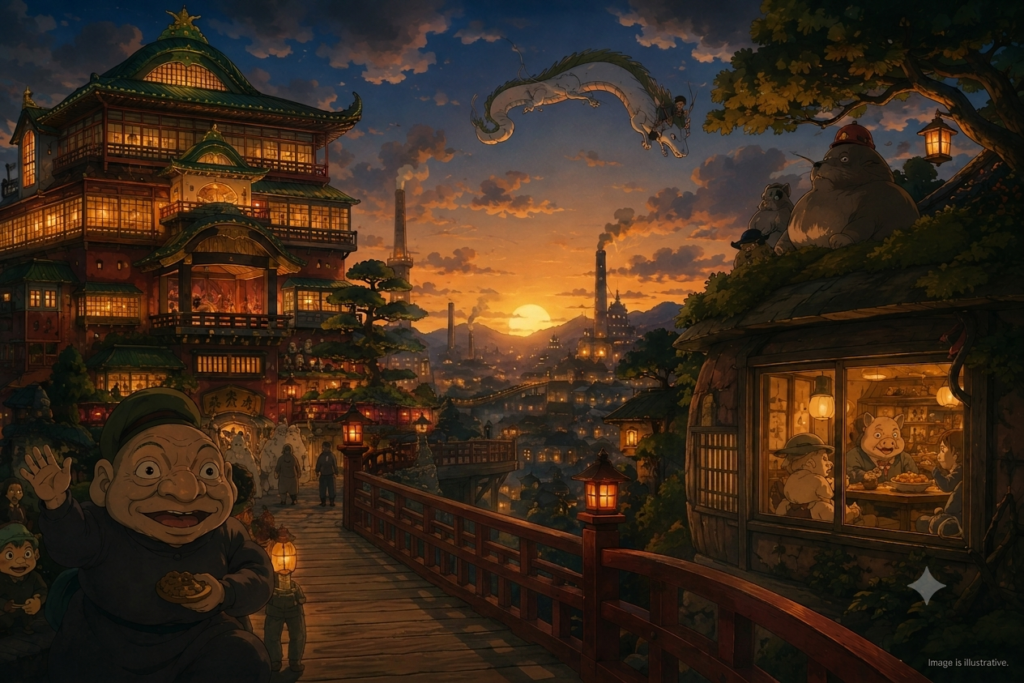
9. Spirited Away
Ten year old Chihiro enters a world she does not understand.
There is an enormous bathhouse. Strange gods arrive as customers. Yubaba takes away names. Chihiro becomes Sen and begins to work.
Spirited Away can be enjoyed anywhere in the world as fantasy.
But viewers familiar with Japan may notice another layer.
One Bite Pick
One of the most interesting things about Spirited Away is that Chihiro does not enter another world and become a warrior.
She gets a job.
She cleans. She serves customers. She learns from senior workers. She makes mistakes and gradually learns how to work.
The bathhouse also draws on images that can feel familiar in Japan, including public bathing, hot spring culture, old architecture, and a world inhabited by countless spiritual beings.
Watch it once for the story.
Then watch it again and pay attention to the Japanese cultural details in the background.
10. Howl’s Moving Castle
A giant castle walks across the landscape.
That image alone is unforgettable.
But Howl’s Moving Castle is more interesting than its visual spectacle.
The original novel was written by British author Diana Wynne Jones. Miyazaki then added his own concerns about war, aging, identity, and destruction.
The result is both an adaptation and something distinctly his own.
One Bite Pick
Treat the castle almost as another character.
It groans. It smokes. It limps. It looks mechanically impossible.
And yet, after spending enough time with it, the machine begins to feel strangely alive.
If you enjoy the movie, read the original novel afterward.
You may be surprised by how differently the same characters and ideas are used.
11. Ponyo
Ponyo was released in 2008, at a time when CG and digital technology had already become standard in animation production.
Miyazaki moved in almost the opposite direction.
The film placed extraordinary emphasis on hand drawn animation and avoided relying on computer generated imagery.
You can feel that decision most clearly in the sea.
Water does not behave like realistic water. Waves transform, run, swell, and move almost like living creatures.
The goal was not to simulate reality.
It was to create a sea that could only exist in animation.
One Bite Pick
At the time, many Japanese viewers also saw glimpses of Miyazaki’s production process through NHK documentaries and other television programs.
What they saw was very different from the gentle atmosphere of the finished film.
Miyazaki could obsess over details that most viewers would barely notice.
Even the way a small seagull moved in the background could become the subject of intense criticism if he felt the motion was wrong.
For the audience, it might pass in a few seconds.
For Miyazaki, it still mattered.
That level of attention helps explain the extraordinary amount of work behind Ponyo.
The film has been reported to contain 1,140 cuts and 170,653 drawings in total, including 150,084 key animation drawings.
Why go that far by hand in 2008?
Watch the sea, the water, the fish, the hair, the waves, and even the tiny birds at the edge of the frame.
Behind Ponyo’s soft and playful appearance lies an enormous amount of manual work.
Once you know that, the film looks very different.
12. Whisper of the Heart
If you hear Studio Ghibli and think only of films directed by Hayao Miyazaki, watch Whisper of the Heart.
The director was Yoshifumi Kondo.
There is no magical kingdom. No monster. No world ending threat.
The story follows Shizuku Tsukishima, a girl living in suburban Tokyo who begins wondering whether she is capable of creating something herself.
One Bite Pick
The most important part of Whisper of the Heart is the fear of creating before you know whether you are talented enough.
You see someone else moving forward. You compare yourself. You become anxious.
Then you decide to make something of your own, only to discover how inexperienced you really are.
Writers, artists, manga creators, animators, musicians, and anyone who has ever wanted to create something may recognize that feeling immediately.
It is one of Ghibli’s quietest films.
It is also one of its most honest.
13. The Wind Rises
The Wind Rises brings Miyazaki’s fascination with aircraft directly into real Japanese history.
Its protagonist is based on Jiro Horikoshi, the aeronautical engineer best known for designing aircraft including the Mitsubishi A6M Zero.
The film presents a contradiction.
A person wants to create something beautiful.
That creation becomes part of war.
Beauty and destruction exist inside the same machine.
One Bite Pick
Watch Porco Rosso before The Wind Rises.
Both films are filled with aircraft, but those aircraft mean very different things.
In Porco Rosso, flying can feel like freedom, romance, escape, and pride.
In The Wind Rises, the dream of flight collides with history.
Miyazaki spent decades drawing aircraft with obvious affection.
Here, he asks what happens when that affection meets the reality of war.
The more Miyazaki films you have seen, the more complicated this movie becomes.
14. The Boy and the Heron
The Boy and the Heron was released in Japan in 2023.
Even before audiences saw it, the film had already become unusual because of how little they knew about it.
The Japanese release deliberately avoided the kind of extensive trailers, plot explanations, clips, and promotional material that normally accompany a major film.
Audiences entered theaters with remarkably little information.
That made the act of discovering the film part of the experience itself.
One Bite Pick
Do not worry too much about understanding everything the first time.
And if possible, do not make this your first Miyazaki film.
Watch some of his earlier work first.
Then come back to this one.
You may notice echoes of earlier films, along with ideas about aging, death, creation, inheritance, and what one generation leaves to the next.
If you begin with The Castle of Cagliostro and eventually arrive here, you are not only watching a list of animated films.
You are watching one filmmaker return to certain questions for more than four decades.
Why Japanese People Still Watch Ghibli
Ghibli films are not movies that Japanese people watch once and leave behind.
A child watches My Neighbor Totoro. A few years later, they discover Princess Mononoke or Spirited Away. As an adult, they return to Porco Rosso or Kiki’s Delivery Service and notice things they completely missed as children.
Then one day, they may watch those same films with their own children.
That cycle has continued for decades.
It is why Japanese people from different generations can talk about the same Ghibli scenes.
A film being from the 1980s does not necessarily make it feel old. A film being released before you were born does not mean you do not know it.
With Ghibli, that sense of distance is much weaker.
There was the era of waiting for television broadcasts. The era of replaying VHS tapes and DVDs. And now, the present.
The way we watch movies has changed, but the films have continued to pass from one generation to the next.
One image can bring back an entire world.
A melody by Joe Hisaishi can bring back not only a scene from a film, but also the person you were when you first watched it.
That is why Ghibli is not simply a collection of animated films in Japan.
For many Japanese people, it is a shared memory that has been with us since childhood, and a part of modern Japanese culture itself.
Reference
Studio Ghibli
Studio Ghibli Official Corporate Profile